Novel - About

A journey of 1000 miles...

A contemplative novel exploring consciousness, love, and the fractured architecture of modern life.

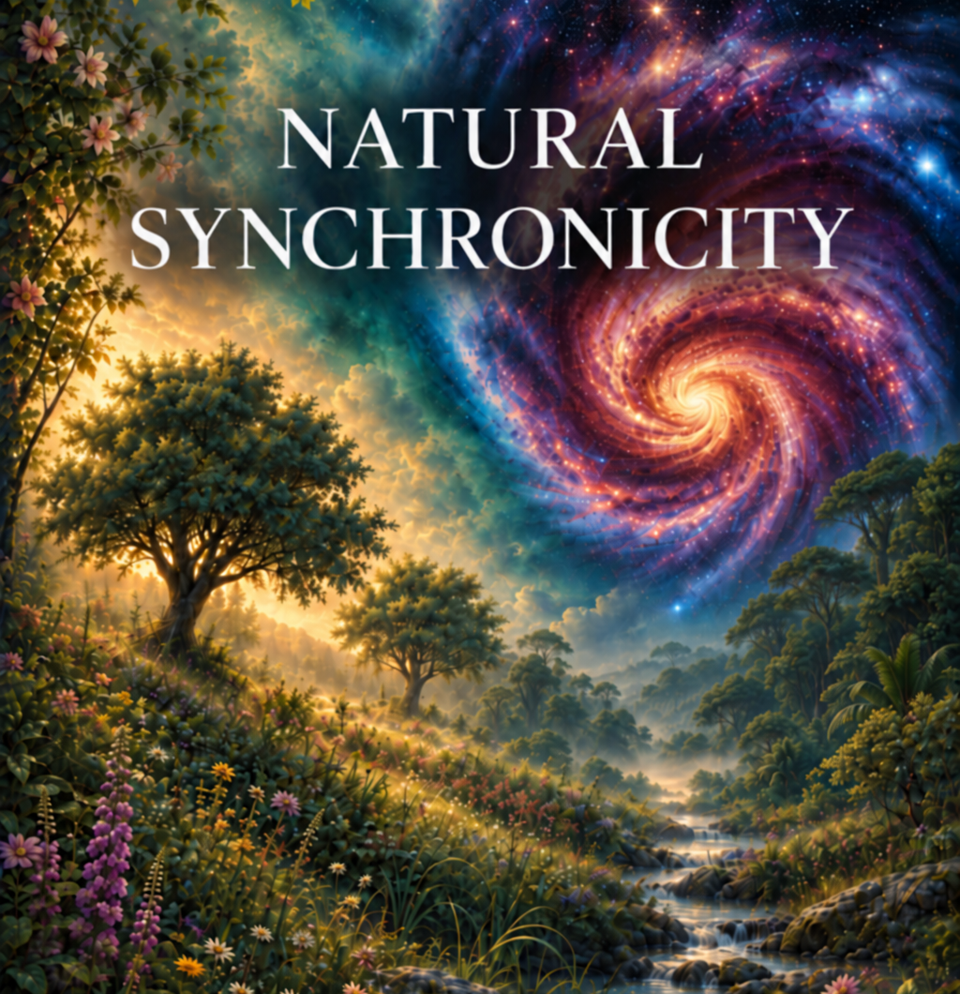
Natural Synchronicity is a contemplative philosophical novel that follows two travellers, Iona and Koan, as they move through a fractured modern world while searching for something that cannot quite be named.

Rather than unfolding as a conventional plot-driven story, the narrative develops through encounters—with landscapes, cultures, ideas, and with each other. Through these encounters the novel quietly explores questions about consciousness, love, society, and the nature of reality itself.

Set against the background of contemporary life—bureaucratic systems, economic pressures, and the subtle alienation of modern structures—the story looks at society with clear eyes. Yet it does not propose utopian solutions or ideological reform. Instead, it suggests that genuine freedom arises through a shift in perception: the recognition of awareness itself as the ground of experience.

At the heart of the novel lies the relationship between Iona and Koan. Their connection is not presented simply as romance, but as a moment in which the apparent boundary between two individuals briefly dissolves. The love between them reveals the possibility that what appears as separation may conceal a deeper unity. At the same time, the narrative remains philosophically honest: such recognition cannot ultimately depend on another person and must be realised independently within one's own awareness.

The world portrayed in the novel—marked by institutional hierarchy, debt-driven economics, and ecological carelessness—is not treated as an enemy to be conquered nor as a system easily perfected. Instead, it is shown as a reflection of a deeper condition: a collective forgetting of the nature of consciousness itself.

For this reason the story does not conclude with society transformed or liberation achieved through external change. It ends more quietly, with two individuals who have come to see their lives differently. The suggestion is that clarity does not remove us from the world but alters our relationship to it.

Awareness, the novel proposes, remains untouched by the circumstances in which it appears.

Natural Synchronicity therefore functions as more than a narrative. It is an invitation to slow down, to observe, and perhaps to notice something about the nature of the consciousness doing the reading.

The novel also serves as the threshold to a broader philosophical exploration that includes symbolic language, contemplative inquiry, and an applied framework for living known as the Natural Synchronicity project.


1. Explore the Work

Read the Novel
The full text of Natural Synchronicity is available to read online.

Key Themes
An exploration of consciousness, love, modern society, and the nature of awareness.

The Natural Synchronicity Project
The wider project includes symbolic systems such as the Origin and Resonance Glyphs, along with philosophical codices and practical explorations in lived ethics.


2. A Note to the Reader

Natural Synchronicity is not intended as a conventional novel or a prescriptive philosophy. It is best approached slowly, as a contemplative work that invites reflection rather than conclusion.

In this sense the story is less about following a narrative toward resolution and more about noticing something that may already be present within the act of reading itselfalong with philosophical codices and practical explorations in lived ethics.


3. Who This Book Is For

Natural Synchronicity is not written for the general fiction reader. It speaks most strongly to a particular kind of person.

The reader who resonates with this work is usually someone who has already sensed that the dominant frameworks of modern life — economic, institutional, cultural, and psychological — do not fully account for something they know to be real.

This reader is often drawn to contemplative or philosophical literature. They may have encountered writers such as Hermann Hesse, Jiddu Krishnamurti, Alan Watts, Thoreau, or the Taoist and Buddhist traditions. What attracts them to these works is not doctrine or belief, but the sense that the writing is pointing toward a deeper recognition about the nature of consciousness.

Many readers of this book have a complicated relationship with modern society. They recognise its achievements, yet feel increasingly alienated by its structures of constant distraction, economic pressure, and institutional abstraction. They may care deeply about social and ecological problems, but have come to suspect that the root of these problems lies deeper than policy or ideology.

Natural Synchronicity does not attempt to resolve this tension through political solutions or spiritual systems. Instead, it explores the possibility that clarity begins with a different relationship to consciousness itself.

For readers who have already glimpsed moments of stillness — perhaps in nature, in meditation, or in profound encounters with others — the novel may feel less like discovering something new and more like recognising territory they have already visited inwardly.


4. Who This Book Is Not For

This work may not resonate with readers who:

  • prefer fast-moving plot-driven stories
  • are looking for practical self-help methods or spiritual techniques
  • want philosophical arguments presented in a formal analytical style
  • are seeking political solutions or ideological critique alone

Natural Synchronicity is best approached slowly, as a contemplative work that invites reflection rather than conclusion.


5. A Final Note

The decisive factor in whether someone resonates with this work is not their background or beliefs, but whether they have had a particular experience — even briefly.

A moment in which the ordinary sense of being a separate self softens.

A meeting with another person that reveals unexpected unity.

A quiet awareness in nature where the boundary between observer and world feels less certain.

Readers who recognise such moments will understand what the novel is pointing toward.

For them, encountering this book may feel less like discovering something new and more like finding a map of territory they have already begun exploring.


Read the Novel →